
Support TFG by using the links in our articles to shop. We receive a small commission (at no extra cost to you) so we can continue to create helpful free content. We earn from qualifying purchases made to the featured retailers. Thank you, we appreciate your support!
In this Local-Approved Japan Packing List, find out what to wear in Kyoto from Masae, who lives in Kyoto. She’s traveled around the entire country and studied for four years in Kyoto. Thank you, Masae! Keep reading to find out what to wear in Kyoto Japan!
Japan Packing List for Kyoto
Japan is a mix of modern and conservative–a melting pot of technology, fashion, tradition, and the arts. Japan is considered a great travel destination in Asia, with a delightful variety of sights and sounds to experience day in and day out.
Foreigners will be pleasantly surprised at the many offerings of the country, ranging from seasonal festivities to modern daily living.
Let’s highlight one of Japan’s favorite tourist spots—Kyoto. A center of arts and crafts, Kyoto exudes the elegance of the country’s history as well as new technology.
It is an obvious mix of old and new, keeping with the old tradition of wearing kimonos and still being fashionable with the latest trends. Surrounded with green foliage, panoramic landscapes, and temples, Kyoto is a traditional Japanese community that local tourists enjoy as much as you will.
Tip: The key to packing light is to create a capsule travel wardrobe which can easily fit into a carryon suitcase with the help of packing cubes to compress your clothing!
Japan Clothing Styles
If you’re planning to visit Kyoto or any districts in Japan, prepare yourself with these packing tips that will help you create your own customized Japan Packing List.
Looking for more Asia Packing Lists? Read this!
Traditional Clothing
In Kyoto, you can still see people wearing a yukata, a type of kimono. In fact, local tourists rent yukatas at special studios, so if this is something you want to experience, you can! Increasingly, it’s prevalent to see more people wearing traditional clothing or dressed as geishas because they mostly only exist in Kyoto. Kyoto is one of the few places you can still see geishas! Be prepared to take many pictures.
Modernly Modest
Japanese people love dressing conservatively but stylishly. You can see that in their famous Harajuku style, which branches out into a number of local costumes and clothing. Masae stresses avoiding low necklines or shorts that are too short as it is not common to see overly exposed cleaves of either direction.
For temples, shrines, and traditional places, it is advised to be respectful and modest to pay respect to the monks and other visitors.
Watch and Learn from the Locals
Local fashion consists of many styles, and as a traveler, you can use it to inspire your own fashion. In general, people love to dress up and take pride in their appearance, from their hair to their makeup and their shoes, so you don’t want a sloppy appearance. Flip flops are not worn outside the home, so wear a pair of regular shoes. Keep this in mind when deciding what to pack for Japan.
We suggest these cute and comfortable travel flats for warm months and women’s leather boots in colder seasons.

Sweater | Pullover | Shirt | Knit | Kimono | Dress | Pants | Jeans | Jacket | Coat | Shirt | Skirt | Boots | Tall Boots | Scarf | Bag
What to Pack for Japan in Winter
During winter, Japan’s temperature can drop below zero. In Kyoto, particularly, temperatures fluctuate between a mild 50-54°F/10-12°C, which means travelers have to brave the frost in order to get the best of the season.
January is considered the coldest month of the year, with the lowest average of 34°F/1°C. It gradually rises in March, with an average of 57°F/14°C.
Start by reading these general tips on packing for winter travel:
- Capsule Wardrobe for Winter
- How to Pack for Cold Weather
- How to Stay Warm in Cold Weather
- The Best Travel Shoes for Winter
Japan Packing List for Winter
During this season, travelers are advised to wear heavy layers of clothing, something the locals are accustomed to as regular houses and inns are not well insulated. If you’re staying in a hotel, you should be able to keep warm, though.
Prepare with gloves or hand warmers, mittens, and thermal leggings if you’re planning to go sightseeing during this snow-capped season in Japan.
Thermal underlayers are suggested beneath all clothing, like this polyster/merino wool top and bottoms, so add them to your Japan packing list. They don’t get smelly easily or need to be washed often.
Local tip: Hand warmers are easily available at drugstores and pharmacies and are very popular during this time of year.
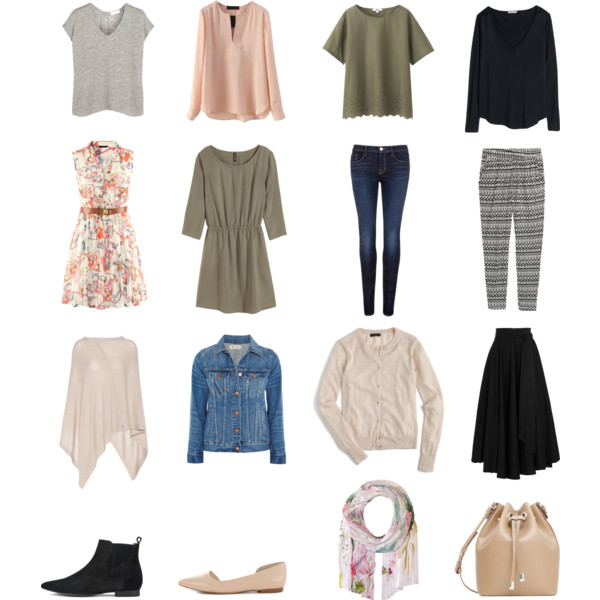
Shirt | Blouse | Tee | Top | Dress | Dress | Jeans | Pants | Poncho | Jacket | Sweater | Skirt | Boots | Flats | Scarf | Bag
What to Pack for Japan in Spring
Japan has a major facelift during spring, when colors flourish from the melting snow and dazzle the landscape. One of the most prominent symbols of the country occurs during this season: the sakura (cherry blossoms).
These blooms stir from their winter sleep and endow the region with a lovely pink color. Spring fashion in Japan can commonly be associated with this hue.
Start by reading these general tips on packing for spring travel:
- How to Pack for Trips with Mixed Weather
- How to Layer a Summer Dress for Spring
- Basic Travel Wardrobe for Spring
- Best Shoes for Traveling in Spring and Fall
Japan Packing List for Spring
During spring, the weather is still chilly and windy, but it is warming up a bit. Take lighter pieces of clothing and layer them. Bring a jacket or a cardigan for extra comfort. You will see most girls wearing comfy flats, so make sure you carry a comfortable and cute set of shoes.
Remember, always check the weather before you go. You may need to follow the autumn packing tips instead!
Local tip: Dress as the locals do in cherry blossom colors!

Tee | Shirt | Tank | Blouse | Dress | Dress | Jeans | Shorts | Vest | Poncho | Top | Skirt | Flats | Sandals | Hat | Bag
What to Pack for Japan in Summer
Summers in Japan can be hot, humid, and unbearable, reaching up to mid 90°F/30°C. This is the best time to strip your heavy layers of clothing and wear a comfy tee, denim, or a summer maxi dress paired with a smart top.
Start by reading these general tips on packing for summer travel:
- Capsule Wardrobe for Summer
- Cute Summer Dresses
- Lightweight Jackets for Easy Layers
- Beach Sandals for Hot Weather Vacations
Japan Packing List for Summer
Late April to May is a pleasant time, as the chills from the winter slowly depart into a mild temperature. However, June to July is rainy season; make sure you bring your umbrella with you.
August is Japan’s hottest summer peak, but it is also a culminating season for many of the country’s matsuri (festivals). During this season, you can enjoy nightly hanabi (fireworks).
Local tip: Prepare colorful outfits during this happy festival season!

Shirt | Pullover | Shirt | Sweater | Dress | Dress | Jeans | Jeans | Sweater | Coat | Shirt | Skirt | Boots | Flats | Scarf | Bag
What to Pack for Japan in Autumn
In autumn, Japan boasts beautiful, colorful foliage, especially in Kyoto. You can visit scenic sites in all their earthly beauty. The weather is still warm in September but it starts cooling down in October and by November it’s wintry cold.
Start by reading these general tips on packing for autumn travel:
- How to Pack for Trips with Mixed Weather
- How to Layer Clothes
- Use a Summer Dress to Pack Light in Fall
- Best Shoes for Traveling in Spring and Fall
Japan Packing List for Autumn
During this season, your packing list for Japan should include boots, as well as your favorite autumn color wear, like browns, reds, and yellows, which are trendy this season.
These colors are reminiscent of the koyo (red leaves) often seen in the surroundings of Mt. Fuji or along the many delightful temples in Kyoto.
Local tip: A hip length, medium coat is suggested for this time of year.
Travel Tips to Remember
- When in Japan, why not try dressing yourself in the national Japanese dress? The kimono and yukata are popular locally in Kyoto and can be rented in local studios.
- In winter, try dining on hot pot “nabe” and visiting hot spring/public baths, to warm your body and mind.
- Prepare yourself with a few Japanese words as you travel; this is important in greeting people, as they can be modest with their English. Study a few basics, like Konnichiwa! (Hello), Sukimasu (to like) and Dokoni imasu (where) to get you around. Additionally, learn a few of their customs to know how to respectfully treat the locals.
Now that you know what to wear, you can create your own custom packing list! To learn more about customizing TFG’s Packing Lists to meet your needs, please read this guide.
What are the essentials in your Japan packing list? Please comment below!
For more Asia packing lists, please read:
- Packing List for Japan: Tokyo
- Southeast Asia Backpacking Packing List
- 10 Step Packing Guide for Southeast Asia
Suggested Travel Resources:


which type of rain wear do you recommend for a 2 week trip in November? Trench coat? Thigh length
rain jacket? thank you
Hi Carol, to get the best advice about packing for Japan at that time of year, I would highly recommend that you join our TFG facebook group and post your question there: https://www.facebook.com/groups/travelfashiongirls/
It’s a fabulous community of helpful female travelers that love to share all their amazing travel advice and recommendations.
Have a brilliant time on your travels.
Thank you very much for the information. I’m planning a trip to Japan this October. this information is very useful. Thank you once again
I love Japan!!!
Such an amazing place!
Thanks so much for this! I’m headed to japan for 3 weeks in August and was wondering what to pack! I’m excited to create my japan capsule wardrobe!
That’s great to hear! Have a wonderful trip 🙂
Hi! I truly enjoyed the blog post but would like to ask if short skirts and dresses are fine for Japan (Tokyo & Osaka) in mid may? Im not too sure if those are sufficient for the Spring weather in mid May and would like to have some comments! (: Looking forward to hearing from you and thanks a lot in advance!
Hi Tracy, I’d suggest always checking the weather before you go and making a decision based on that. If mixed weather is expected, follow these tips: https://www.facebook.com/TravelFashionGirl
I’ll also post your question on TFG’s facebook page to get more feedback so stay tuned for that!
Great article! Also, in the summer remember to pack your jellies! They’re way less cumbersome than rain boots, and you don’t have to worry about a sudden down pour.
Check out my tips on what to wear in Japan here: http://venturetravelist.wordpress.com/2013/11/17/what-to-wear-japan/
Cheers!
Regan
Great tip! Let me know if you’d like to do a guest post on TFG 🙂
Would love to do a guest post! Shoot me an email and we can coordinate 😉
I shall get in touch 🙂
Hi
Is it alright to wear rain boots at the end of April in Tokyo & osaka? Or it’ll be warm by then and wearing flat loafer in fine? Thanks
Hi Farah, I’ll go ahead and post your question on the TFG Facebook page to get reader feedback for you: https://www.facebook.com/TravelFashionGirl?ref=hl Keep an eye out. Thanks!
Love your lists!! But… my biggest problem with Japan packing is SHOES.
– Lots of walking, from place to place, but also from station to station – the major way to get around in the big cities. So sensible shoes with .. ?? socks – not always a good look ?? shoe-liner/sockettes??
– Shoes often need to taken off and put on QUICKLY – the locals seem to be able to wiggle in and out of lace-ups, but I haven’t learnt to do this yet.
– Slow shoe on/off routine gets you left behind… or, even worse… causes inconvenience to your group!!
So if there are any old Japan-Hands (or should that be Japan-Feets), I would love some advice as my packing starts with and revolves around footware.
Hi there! I posted your question on the TFG Facebook page and got lots of tips, stop by and check them out: https://www.facebook.com/TravelFashionGirl/posts/670907752932896
hi! my friend and i will be visiting japan this september 30 to october 05 just a few days to unwind from work. we don’t know what kind of clothing to bring because we’ve been searching the net and it says it’s autumn in october so during this 1st week of october we thought it’s still hot? because we’re thinking that cool days starts in the middle or last week of october? just wanna ask if low-cut boots is ok to bring? or do we need to bring high- cut boots with thick sweater? thank you so much.
Hi, may I know whether I should bring trenchcoat along for autumn in Japan, specifically October?
Somehow your website really give useful tips to me. I’m going to further my study in Fukuoka, enroll in fall semester. Still figure out what should I bring from Malaysia to feel the autumn season in Japan. Any suggestion? Thank you. 🙂
Glad you found it useful! I’ll post your questions on Facebook to get feedback from other travelers. Keep an eye out for answers. Thanks!
These are the responses for you:
Maharani Dian Permanasari: I am autumn season has just started here, the weather is getting colder nowadays, and raining too.. so it might be better to prepare your comfy boots (preferably leather or waterproof one, or anything that’s comfy), some long sleeves and jackets (no need for the thick one yet), and your favorite pair of jeans -of course! but then again, it depends on how long will you stay here. if you’re going to stay more than 3 months, maybe it’s better to buy boots and coats here
Kaylin E. Stephens: If it’s anything like Korea in fall (fukuoka is only 2-3 hrs by boat from where I used to live in Korea so I imagine it is) it will be beautiful and pleasant weather. Not hot or cold. A little chilly at night (light sweater etc) and t-shirt and jeans in the day.
Planning my second trip to Japan next spring March and April (first one was a summer vacation). wouldn’t dresses be to light for that weather? I was thinking I’ll need jeans, sweaters and jackets, scarves and that kind of stuff. am I wrong? Thank for your advice by the way.
I think this was a brief list but it will be revised and expanded, thanks for commenting!
I am SO happy I found this site. I’m headed to Japan for the first time in August and have been having packing anxiety. Thanks so much for the great tips!
Tara
Hi Tara, I’m glad you found the site and you’ve found it helpful 🙂 Have a great trip!
I’m going to Japan in mid September organised by my school. We are leaving on the 18th and arriving on the 19th. I was wondering, what clothing was appropriate to pack. Btw I’m 14. Thanks 🙂
Hi Kim, thanks for your question! What an exciting school trip! So far, the best advice is the one found on this page. Follow the guidelines as to what type of clothing to pack in the Autumn section. It tells you what clothing is appropriate for the weather. I will have another Japan packing list in about a month so stay tuned 🙂 Thanks for reading!
Nice and chic tips Alex. It would be so helpful for me if I got those at my previous trip at Kyoto.Waiting for the next trip.I am pretty sure that your blog will help me for the next trip.
Thanks.
Thanks! I’m glad you found it and you like it 🙂
Short shorts are perfectly fine in Japan – legs are the cleavage of Japan. What IS seen as unacceptable is showing your shoulders. Try to avoid strappy tops or halterneck tops. If you have things with this kind of top, find a light bolero or lace cardigan to put over it – one with kimono sleeves is perfect for keeping your pits cool at the same time.
Rather than renting yukata, tourists (Japanese and foreign alike) will be going to “geisha experience” days. For about 10,000 yen you can be dressed up like a geisha or maiko (trainee geisha – they wear the brighter and prettier kimono) and have professional photos taken. If you see a geisha on the streets in Kyoto, 9 time out of 10, it won’t be a real geisha but one of these tourists.
For “like”, “suki” (pronounced like ‘ski’) is enough. “sukimasu” is incorrect, if you want to make it formal you should say “suki desu”. With “where”, “doko” (pronounced like ‘doh koh’) is enough. Most people in Kyoto will be able to speak English, though.
As the commenter above said, you’ll be slipping your shoes on and off all day so stay away from sandals and stick to socks and shoes (like ballet flats with pop socks).
Great post though! Thanks for sharing!
Thank you so much for the great tips!
Yes shorts are totally fine in Japan but not shorts that show your butt ‘cleavage’ but then again they’re not really okay anywhere lol 😉
It’s really helpful to have local residents like you and Masae the contributor for the post that can provide people with accurate information for travelers!
Thanks again!
Can you please offer guidance on a formal event in mid-May in Kumamoto that I will be attending including a reception in the castle and a Presidential dinner for a medical conference? Very few foreigners will be attending and I am thinking a spring cocktail dress that is classic and elegant, maybe lace, demure but well tailored with nude heels, with a wrap or bolero. I am a fairly tall, slim platinum blonde and want to look great for my date who is an honored guest but not look too showy.
Many thanks.
Hi Amy, I asked my friend Masae and this is what she had to say:
“I think what she prepared to wear sounds just fine as long as it is not obviously boobs showing outfit or entirely gold, silver coloured or glittering just like a singer on a stage… you know what I mean.
Sounds like she is being very careful how she dresses and people will understand that by her respectful manner : )”
Hope this helps!
Don’t forget to bring plenty of socks (with no holes) and lace-less shoes that are easy to slip on and off when entering temples!
Great tips and pictures. I didn’t wear a yukata in public, but i liked wearing the Japanese pyjamas at hotels and Ryokans, just for fun 🙂
Thanks Claus! Japanese pajamas sound cozy 🙂
Great topic Alex! Kyoto is my favourite city in Japan, don’t forget to pack lots of pretty floral dress in spring time inspired by the cherry blossom season! x Juliet
Thanks Juliet! It sounds like the best time to be in Japan – nature and fashion are in bloom 🙂